Aug. 20, 2025

Is It Better To Buy Now or Wait for Lower Mortgage Rates?

For good reason, mortgage rates are still a heated topic. The bond market responded almost immediately after the most recent jobs report was released with lower-than-expected results. Consequently, mortgage rates fell to their lowest level of the year (6.55%) in early August.
That might not seem like much, but almost all buyers have been waiting for rates to drop. And even a seemingly minor decline like this one rekindles optimism that rates will eventually start to decline. However, what is reasonable to anticipate?

Rates are not anticipated to drop significantly anytime soon, per the most recent projections. According to the majority of experts, they will remain in the mid- to low-6% level until 2026.

That is to say, no significant changes are anticipated. However, minor changes like the one we just witnessed are still possible.

Every time economic news changes, there's a potential that mortgage rates will change as well. We'll also have a clearer idea of the direction of the economy and inflation, as well as how interest rates will react, because there are a lot of reports coming out this week.

What Price Would Encourage Buyers to Relocate?

6% appears to be the magic number that most buyers are keeping an eye on. Furthermore, it has actual effects and is not merely a psychological standard. According to a new National Association of Realtors (NAR) research, if rates rise to 6%:

The median-priced home would be within the reach of 5.5 million more households.

And within 12 to 18 months, almost 550,000 people would purchase a home.

That's a significant amount of unmet demand awaiting approval. And as you can see from the graph above, Fannie Mae believes we'll reach that milestone the next year. That brings up a crucial query: Is waiting for reduced pricing truly worthwhile?

Because this is the compromise. You must acknowledge that many others are also waiting for 6%. Additionally, you may see increased competition, fewer options, and higher property prices when rates do start to slowly decline and more buyers enter the market at once. This is how NAR describes it:

"Homebuyers who want lower mortgage interest rates may eventually get what they want, but for now, they will need to choose between waiting and buying."

Think about the special window that is currently available:

Increased inventory means more options.

Slower price rise means more affordable prices.

You might have more negotiating leverage, which could result in a better bargain.

All of these chances will go if demand spikes and rates decline. The NAR states that buyers who are waiting for lower mortgage rates might be passing on a significant market opportunity as a result.

The bottom line

This year, rates are not anticipated to reach 6%. However, when they do, other buyers will reenter the market, increasing your competition. There is currently a chance for you to have more negotiating power and less pressure, but it may not last long. Everything hinges on the following economic developments.

Visit Keeping Current Matters to learn more.

Posted in General
Aug. 18, 2025

Mortgage rates drop to another new low for 2025

Despite core inflation running at 3.1% year over year, according to this week's CPI report, mortgage rates hit a new 2025 low today. Any worries about inflation are now overshadowed by improving mortgage spreads and softening labor data. The scenario would be different if the jobs statistics exceeded estimates.
Mortgage rates have fallen to a record low of 6.53% for the year, according to Mortgage News Daily. With the most recent jobs data, Federal Reserve Chair Jerome Powell finally has the cover he needs to decrease the Fed funds rate, despite intense pressure to do so. But as usual, the bond market usually outpaces the Fed. These trends have previously reversed and rates have increased, but as of right now, 2025 marks a brand-new low.

Lower-rate housing data?

Why is it crucial that mortgage rates approach 6%? Well, historically, when mortgage rates were between 6.64% and 6%, the housing data tended to get better. I will now examine the data more closely to determine whether this will be the third time this has happened since late 2022.

The buy application data for existing house sales showed a 17% year-over-year growth and a 1% week-over-week increase, reflecting the recent strong performance of homebuilder stocks. For purchase applications, this represents consecutive weeks of positive weekly and year-over-year data. Additionally, data on purchase applications has demonstrated double-digit growth for 14 consecutive weeks compared to the previous year.

The fact that this year's new listing data is higher than last year's and that comps are so low has contributed significantly to that gain. In the past, nevertheless, the week-to-week data tended to improve when rates approached 6%.

The 10-year yield is currently at 4.24%, and aside from the Godzilla tariffs, it has not dropped below 4% this year. If labor data worsens and the inflation growth rate stays constant, it will be interesting to see how the bond market responds. We might be looking at close to 6% this year if mortgage spreads keep getting better and the 10-year yield hits 4% once more, as it did in recent years.

In conclusion

We will be able to determine whether the 10-year yield responds negatively to the PPI inflation report when it is released tomorrow. A rate drop at the next Fed meeting seems questionable, according to some Federal Reserve members who have adopted a rather hawkish position today. Given how awful the last employment report was, I question their position on this.

One thing is certain, though: in recent years, the 10-year yield has tended to fall whenever there has been a scarcity of economic growth in the data, which lowers mortgage rates. The difference currently is that mortgage spreads have improved a lot. As a result, mortgage pricing is not greatly impacted even when the 10-year yield rises, as it did last week, because spreads are rising in tandem with higher yields.

Visit Housingwire to learn more.

Posted in Market Updates
Aug. 17, 2025

Top Ten Things to do in Cincinnati This Weekend August 22-24

For your visit to Cincinnati between August 22-24, 2025, here are ten things to do this weekend.


Festivals & Celebrations


  1. Germania Society Oktoberfest: Get a taste of German culture at this festival, running all weekend long from August 22-24. You can enjoy traditional food, music, and activities.

  2. St. Ignatius Iggy Fest: This is another lively festival happening throughout the weekend. It's a great opportunity to experience a local community celebration.

  3. Black Art Speaks 5th Year Anniversary: On August 23, join this special 5th-anniversary celebration. With an estimated crowd of 400, it's a significant event for the local arts community.

  4. Ault View Street Party: Looking for a smaller, neighborhood-focused event? The Ault View Street Party on August 23 offers a more intimate gathering.

  5. 2025 Griest Avenue Block Party: Another local block party on August 23, this is a chance to mingle with residents and experience a true neighborhood get-together.


Concerts & Performances


  1. Rob Thomas: The All Night Days Tour: See the Grammy-winning Matchbox Twenty frontman, Rob Thomas, perform at the PNC Pavilion on Saturday, August 23.

  2. Caamp: This band will be playing at The ICON Festival Stage at Smale Park on Sunday, August 24. It's a large-scale concert event with an estimated crowd of 6,500.

  3. Phil Rosenthal: The producer and writer from "Somebody Feed Phil" is bringing his show to the Taft Theatre on Sunday, August 24.

  4. Tchaikovsky: Iolanta: The Queen City Opera will be performing Tchaikovsky's opera "Iolanta" at the Aronoff Center on Saturday, August 23 and Sunday, August 24.

  5. Stacy Mitchhart: Catch a blues show at Live at the Ludlow Garage with Stacy Mitchhart on Friday, August 22.


Posted in General
Aug. 15, 2025

Top Ten Things to do in Cincinnati This Weekend August 15-17

Here the top ten things to do in Cincinnati this weekend August 15-17

Events & Special Activities (August 15-17, 2025)


  1. Black Family Reunion 2025: This large-scale event is scheduled for August 16. With an estimated crowd of 5,000, it's a major gathering that promises a lively and culturally rich experience.

  2. St. Mary's Fun Fest: On August 15, you can check out this fun fest. It's a smaller event with a community feel, perfect for a Friday outing.

  3. Med Pace 5K 2025: If you're a runner, or just want to cheer on some participants, this 5K is happening on August 16.

  4. Cincinnati Art Museum: The museum has several events planned for the weekend. On August 15, there are "Public Baby Tours" for families with infants. On August 17, they're hosting "Art in Motion," an inclusive movement class for adults of all abilities. The museum also has ongoing exhibitions, including "Cycle Thru! The Art of the Bike," "Farm to Table: Food and Identity in the Age of Impressionism," and "Tintoretto's Genesis."


Popular Year-Round Attractions


  1. Cincinnati Zoo & Botanical Garden: A must-do for any visitor, the Cincinnati Zoo is a world-renowned attraction. It's home to a diverse collection of animals and stunning gardens.

  2. Findlay Market: Operating in the same building since 1855, this is a Cincinnati tradition. It's a great place to explore local produce, artisan products, and a wide variety of food vendors.

  3. National Underground Railroad Freedom Center: Located downtown, this important museum tells the stories of freedom's heroes, from the era of the Underground Railroad to modern times.

  4. Cincinnati Museum Center at Union Terminal: Housed in a historic Art Deco train station, this center includes the Cincinnati History Museum, the Museum of Natural History & Science, and the Duke Energy Children's Museum. It's an all-in-one destination for history, science, and family fun.

  5. Explore Smale Riverfront Park: This beautiful park along the Ohio River offers walking trails, gardens, playgrounds, and even swings with a view of the iconic Roebling Suspension Bridge. It's a fantastic spot for a relaxing walk or a picnic.

  6. Taft Museum of Art: Known as one of the finest small art museums in America, this National Historic Landmark houses an impressive collection of European and American master paintings, as well as Chinese porcelains and other decorative arts.

Posted in General
Aug. 13, 2025

Thinking of Selling the Family Home? Here’s How To Make the Most of It

It takes strong reasons to get older people to sell their homes these days, and more than half of them say they'll never do it.
For those who do sell, they may want to use the equity in their home to pay for medical bills, get away from the hassles of upkeep and maintenance, or find a quieter place to live in a warmer environment.

But another reason is coming into play more and more: grown children who need help.

Baby boomers are finally getting used to retirement, and many of them have kids who already have families or are planning to have their own. And their homes may be the most important thing they have that can be used to help the next generation and the ones that will come after.

Why some people don't sell and others do

Realtor.com® research shows that baby boomers own between $18 trillion and $19 trillion worth of real estate across the country. This is about twice as much as millennials claim.

What is the best way for people in that age to pass on their wealth without taking a big tax hit? We want to know so we can give "warm hands" instead of "cold."

"Most people who are thinking about selling their home do so because they want to keep the value of the asset and leave something to their children." But the way and time of the sale can have very different tax effects, says Laura Cowan, head of 2-Hour Lifestyle Lawyer and an estate planning lawyer. Because the amount of money your heirs may owe the government depends on how and when you move the house, whether you do it while you are still alive or after you die.

If you give your kids the house while you're still living, they will get the full amount you paid for it, which could mean big capital gains taxes in the future. When you die and leave something to someone else, the value "steps up" to the market price. This means that the taxes are usually lowered or eliminated.

"Everything is different." "It might not matter as much right away if the kids don't plan to sell the house any time soon," says Cowan. "However, the step-up in basis can usually lead to a much better tax outcome."

Let's look at the case of a person who bought a home in 1985 for $82,800, which is the median price. It's likely worth $423,100 now that that home is priced in the middle. If they sell, this might sound like a lot of money, but based on their situation, they could have to pay capital gains tax on up to $90,000. But if the house is passed down after the owner has died, that tax might not apply because of the step-up in base.

This means that giving with "cold hands," as gross as that sounds, is often better from a tax point of view.

Make the most of your home sale with the Hersey Group

Posted in General
Aug. 11, 2025

Mortgage Applications Today: Home Loans Surge as Borrowers Take Advantage of Lower Rates

According to the Mortgage Bankers Association, the number of mortgage applications rose by 3.1% for the week ended August 1, which led to a rise in the demand for home loans. The rise comes after a 3.8% drop in applications the week before.
Freddie Mac also said that mortgage interest rates stayed rather stable at 6.72% for a 30-year fixed mortgage for the week ending July 31.

The Market Composite Index, which tracks the number of home loan applications, went up 3.1% from the week before when adjusted for the season. The Index went up 3% from the week before, without any changes.

The refinance index went up 5% from the week before and was 18% higher than the same week last year.

The purchasing index, which is adjusted for seasonal changes, went up 2% from the week before. The unadjusted purchasing index went up 1% from the week before and was 18% higher than the same week last year.

The number of homeowners who chose to refinance went up from 40.7% of all applications the week before to 41.5%. The share of adjustable-rate mortgages (ARMs) in total applications went up to 8.5%.

There was a little drop in applications for Federal Housing Administration loans, from 18.8% the week before to 18.5%.

The number of people applying for Veterans Affairs loans went up from 12.2% to 13.3% in the last week. There was also a small drop in USDA loan applications, from 0.6% the week before to 0.5%.

"Last week, mortgage rates went down because Treasury yields went down as economic data releases showed that the U.S. economy was getting weaker. Joel Kan, MBA's vice president and deputy chief economist, says, "As a result, the 30-year fixed rate fell for the third week in a row to 6.77 percent."

"Applications for refinancing rose to their highest level in four weeks after falling for the previous three weeks. The share of refinances went up to about 42%, which is the largest level since April.

Rates for contracts

The average contract interest rate for 30-year fixed-rate mortgages with conforming loan sums ($806,500 or less) went down from 6.83% to 6.77%. For 80% loan-to-value ratio (LTV) loans, the points went down from 0.60 to 0.59, which includes the origination fee. The effective rate went down from last week.

The average contract interest rate for jumbo loans (more than $806,500) with 30-year fixed-rate mortgages went down from 6.74% to 6.65%. For 80% LTV loans, the points went up from 0.51 to 0.59, which includes the origination fee. The effective rate went down from last week.

The average contract interest rate for 30-year fixed mortgages guaranteed by the FHA went down from 6.56% to 6.47%. For 80% LTV loans, the points were down from 0.83 to 0.81 (including the origination fee). The effective rate went down from last week.

The average interest rate on a 15-year fixed-rate mortgage went down from 6.12% to 6.03%. For 80% LTV loans, the points went up from 0.64 to 0.66 (including the origination fee). The effective rate went down from last week.

The average contract interest rate for 5/1 ARMs went down from 6.22% to 6.06%. For 80% LTV loans, the points went down from 0.51 to 0.49, which includes the origination fee. The effective rate went down from last week.

"Borrowers wanted to take advantage of these lower rates, and the number of applications for both purchases and refinances went up over the week," Kan explains. "Purchasing activity continued to lead the way in 2024, as the number of homes for sale has been rising, which has helped homebuying. However, the recent weakness in the economy has made some potential homebuyers less interested."

Calculated mortgage rates

The economy takes a lot of things into account when figuring out mortgage rates, and the length of your loan will also affect the rate you can get.

Fannie Mae says that the 30-year mortgage rate is linked to the yield on the 10-year Treasury note. When the yield on the 10-year Treasury note changes, mortgage rates go too.

The yield on a 10-year Treasury note is based on what people think will happen to short-term interest rates in the economy over the life of the bond, plus a term premium.

Posted in Market Updates
Aug. 8, 2025

Top Ten Things To Do In Cincinnati August 8- August 10

For the weekend of August 8-10, 2025, Cincinnati has a number of specific events and ongoing activities that are perfect for a late summer visit.

  1. Attend the Voices of America Country Music Festival: This multi-day festival runs from August 7th to August 10th and features a lineup of major country stars. While a full lineup isn't available for the 2025 dates, past headliners have included Carrie Underwood and Hardy, making it a great destination for country music fans.

  2. Catch the "Where the Party At Tour" with Nelly, Ja Rule, and Eve: On Sunday, August 10th, at the Riverbend Music Center, you can see these hip-hop and R&B legends on their tour celebrating the 25th anniversary of Nelly's album "Country Grammar."

  3. Go to the 7th Annual Cincinnati SneakerBall: This event, happening on Saturday, August 9th, at TQL Stadium, is a unique and stylish affair. Guests are encouraged to wear their most creative and fashionable sneakers.

  4. Explore the annual 127 World's Longest Yard Sale: While the sale spans many miles, Cincinnati's Northside neighborhood will have its own neighborhood-wide garage sale on Saturday, August 9th, to coincide with this massive event.

  5. Enjoy "Shakespeare in the Park": The Cincinnati Shakespeare Company offers free, public performances of Hamlet at various parks throughout the summer. While a specific schedule for August 8-10 isn't listed, it's a great opportunity to enjoy free theater outdoors. Check their website for the most current schedule.

  6. Take the family to see "Disney Descendants Zombies": On Sunday, August 10th, the Heritage Bank Center hosts a tour featuring the stars and songs from the popular Disney movies, a perfect option for families with kids.

  7. Witness the Red Bull Flugtag: A unique and popular event, Red Bull Flugtag is scheduled for Saturday, August 9th, in Cincinnati. Watch as amateur pilots attempt to fly their homemade, human-powered flying machines off a 30-foot pier.

  8. Go to a Cincinnati Reds game: Unfortunately, the Reds are on the road playing the Pittsburgh Pirates for the entirety of the August 8-10 weekend. However, if you are a baseball fan, they have a home game with a Snoop Dogg post-game concert on Monday, August 11, and a fireworks night on Friday, August 15.

  9. Visit the Cincinnati Zoo & Botanical Garden: The zoo is a fantastic all-ages attraction. During the summer, it's a great place to enjoy the beautiful botanical gardens and see a wide variety of animals.

  10. Explore the breweries and eateries of Over-the-Rhine (OTR): This historic neighborhood is a hub of activity with a lively atmosphere. You can find unique restaurants, craft breweries, and boutique shops, making it a great place for an afternoon stroll or a night out.

Posted in General
Aug. 6, 2025

What Credit Score Do You Really Need To Buy a Home?

Fannie Mae says that 90% of purchasers don't know what credit score lenders want, or they think the minimum score is higher than it is.


Let that sink in. That means that a lot of people who want to buy a home assume they need higher credit than they really do. You might be one of them. And that can make you assume that buying a house is out of reach for you right now, even if that's not true. So, let's take a look at what the numbers truly indicate regarding buying a home and credit ratings.

There isn't one number that works for everyone.

When you buy a house, you don't need to have a certain credit score. That means there is more room for change than most people think. This is what you need to know. The numbers are different, and there isn't a single threshold that works for everyone. And that could let you in on doors you thought were closed to you. Talking to a lender you trust is the best approach to find out more. FICO says:

"Many lenders use credit scores like FICO Scores to help them decide whether or not to lend money, but each lender has its own plan, which includes how much risk it is willing to take." Not all lenders utilize the same "cutoff score," and there are numerous other things that lenders may look at . . .

Why Your Score Still Matters

When you buy a house, lenders look at your credit score to see how good you are with money. They want to know if you usually pay your bills on time, pay back loans, and other things.

Your score can affect the kinds of loans you can get, the conditions of those loans, and even the rate on your mortgage. And because mortgage rates have a huge effect on how much house you can buy, your score may feel even more crucial today. Bankrate says:

When you apply for a mortgage, one of the most essential things lenders look at is your credit score. Not just to get the loan, but also to get the best terms: Usually, the higher your score, the cheaper the interest rates and better terms you'll be able to get.

That doesn't imply your credit needs to be immaculate, though. You could still be able to secure a home loan even if your credit score isn't as high as you'd like.

Want to raise your score? Begin Here

If you talk to a lender and decide you want to raise your score (and hopefully your loan type and conditions too), the Federal Reserve Board says these are some sensible things to do:

This is a huge one: pay your bills on time. Lenders want to know that you can always pay your expenses on schedule. This includes everything, such credit cards, utility bills, and cell phone bills. If you always pay on time, it shows that you are a responsible borrower.

Pay off your debt: The less credit you use, the better. Try to maintain this number as low as you can. That makes you a lower-risk borrower in the eyes of lenders, which means they are more likely to provide you a loan with better terms.

Check Your Credit Report: Get copies of your credit report and fix any mistakes you notice. This can help you get a better score.

Don't Open New Accounts: It may be tempting to get more credit cards to raise your score, but it's best to wait. If you apply for too many new credit cards, your report may show hard inquiries, which might reduce your score for a short time.

The Bottom Line

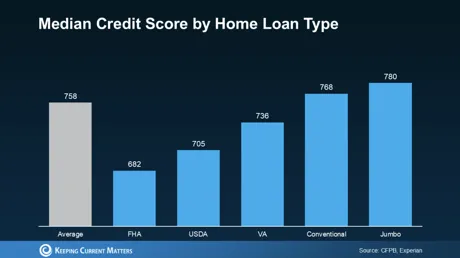
You don't need a flawless credit score to get a loan to buy a house. But having a higher score can help you receive better terms on your mortgage. If you want to know where you are and what your mortgage options are, the best thing to do is go to a lender you trust. Take a look at this graph that shows the average credit ratings of recent home buyers for different types of home loans:

Posted in General
Aug. 4, 2025

First-Time Buyers Flock to Older Homes as Starter Homes Age Out

In the past, those looking to buy a home focused on new building, generally on the outskirts of town, in new projects. But those days are over.
According to a new analysis by Cotality, the rising cost of owning a home means that old and modest homes are now the best starter homes.

The "new" starter home is actually old.
"The starter home has effectively aged out," says Thom Malone, an economist at Cotality and the report's author. "High mortgage rates or a lack of supply make it hard for first-time buyers to buy."

New buildings aren't usually aimed at first-time buyers, unless that buyer has a lot of money.

He argues, "Land costs, building material prices, and a constant lack of housing supply have turned new builds into high-end housing, even in parts of the U.S. that are less expensive."

Also, new constructions usually need a cash deposit of up to 20% of the total cost. That might be a lot of money at today's pricing, more than a young person can afford.

The Cotality study indicates that sales of existing homes are down 2% from last year, while sales of new homes are down 3.43%. This is because there are so many more older properties than newer ones.

The survey says that over 70% of existing homes have less than the usual 2,000 square feet of area that is prevalent in new construction. This shows that many purchasers are choosing a lesser price over greater space. (A starter home, for the sake of this study, is one that is no more than 1,500 square feet.)

Even new homes that are smaller might still be expensive. For example, in April 2025, the typical price of a new home that was less than 1,500 square feet was $320,000.

Realtor.com® says that this is less than the national median price of $440,950 in June, yet it is more expensive than what was available before the COVID-19 outbreak. The median price in April 2019 was $310,000.

Real estate agents all agree that more people are looking for older properties. Affordability is important, but there are other reasons too.

"I've seen buyers choose older homes in more established areas over new construction because they don't want to live in a cookie-cutter neighborhood where all the homes look the same, there are no trees or mature landscaping, and they don't want to deal with all the problems that come with living next to new construction being built all around them," says Cara Ameer, a real estate agent with Coldwell Banker who is licensed in Florida and California.

She also says that older homes usually have bigger lots. "Builders put everything on lots that are 40 to 60 feet wide, and you pay more to have a view instead of backing up to other homes."

"People are definitely moving toward older homes as their first home," says Libby McKinney-Tristchler, an agent with Team AFA/William Raveis in Southport, CT. "For a lot of families with two incomes, the idea of a smaller, easier-to-manage space is also a lifestyle choice. They don't want to spend their weekends taking care of enormous houses or properties.

Clients are searching for something cheaper, of course, as Southport is a costly location with a median house price of $869,000.

"Buyers are telling me they want something that they can afford, and older homes give them that chance," she says.

Andrea Kremer of Rooftop Realty Group showed a little (1,080-square-foot), one-owner house on Edden Lane in Syracuse, NY that was 70 years old. It took barely a week for someone to buy it.

"It's just a matter of supply and demand," she explains. "We have a lot of buyers, but not a lot of stock." If the house is in a good area, priced right, and is something that someone can make their own or is move-in ready to some level, they are selling like hotcakes if they are around $300,000.

The small red four-bedroom fixer-upper had a bidding war and sold for about $50,000 more than the $129,900 asking price.

Kremer recalls, "It was probably the only house in this area for that price."

Bruce Ailion, a Re/Max agent, adds that the shift toward older and smaller homes is also happening in Atlanta.

"Ten years ago, it would have been hard to sell these homes," he says to Realtor.com. But now, homes built in the 1950s that are only 750 to 1,100 square feet are selling quickly, either to people in their 20s and 30s or to their boomer or Gen X parents.

He explains, "One of the few ways to get an affordable detached home is to go smaller and older."

And then there are taxes on property.

"Most counties use the purchase price of a home to figure out how much tax it will have. Jeff Lichtenstein, CEO of Echo Fine Properties in Jupiter, FL, states, "A fixer-upper will have a lower tax base."

More square feet is not always better.
Jonathan Klemm, the CEO of Quality Builders, a general contracting company, says he spotted an opportunity when he bought a small three-bedroom house constructed in 1963 for $311,000 ($173 per square foot) in Lyons, a suburb of Chicago. The average price in the area is $193 per square foot.

Because of his history, Klemm thought he could do the work, save money, and put his own imprint on the house. He thought 1,800 square feet was the smallest space he could live in with his two young girls. It was all they required.

He tells Realtor.com, "A lot of people are more willing to do the work and do small cosmetic changes or live with some of the older styles and upgrade over time." "I wanted something that I knew we could fix up. From the start, I really wanted an older property that needed some cosmetic work.

Many people who buy smaller, older homes think they will survive longer than newer homes.

Jameson Tyler Drew, a real estate investor in Los Angeles, says Realtor.com, "I'll be the first to say it since no one in my industry wants to say it: New homes are crap." He also sells things in Indiana, where he lives.

He notes that a "solid chunk" of his sales come from new homes, but those homes tend to have a lot of problems.

He continues, "These homes—and I'm not blaming any one home builder, because this is a problem across the board—almost immediately have problems after they're built."

"Missing joists, cracked window welds, HVAC installed wrong, and so on." To make things worse, the bigger home builders will battle you tooth and nail before they fix anything substantial that they are in charge of.

"I've seen new homes with foundations that aren't level for some reason. I've seen every kind of mistake that happens when home builders don't work together and use the lowest materials they can find.

He likes old houses made with strong materials that are hard to locate in new construction.

He says, "Floors and joists are often made of American chestnut, which is almost extinct these days." "They constructed floors that were really strong and gorgeous. Even if you don't choose the Victorian palace, the cookie-cutter houses built between 1930 and 1960 still have thicker walls and better materials than dwellings created today. All for a small amount of money.

What did he say? Get old.

He says, "Every day of the week, I will always tell my client to buy an older home instead of a new one."

Posted in General
Aug. 1, 2025

Top Ten Things To Do In Cincinnati August 1- August 3

  • Glier's Goettafest (August 1-3): This is a must-do if you're in Cincinnati during this time! It's a celebration of all things goetta (a regional meat and grain sausage) with innovative food creations, live music, games, and family fun. It takes place at Newport's Festival Park at the Levee.

  • On Point Music Festival (August 1-2): Head to Sawyer Point and Yeatman's Cove for two days of live music featuring various artists, plus a roller rink, beach volleyball, and a pickleball tournament.

  • St. Bernard German Luau (August 1-2): Enjoy a family-friendly event with German and luau-themed food, drinks, entertainment, and a parade on Saturday. This is happening on Washington Ave in St. Bernard.

  • Luke Bryan: Country Song Came On Tour (August 1): If you're a country music fan, catch Luke Bryan with special guests at the Riverbend Music Center.

  • TOTO with Christopher Cross and Men At Work (August 3): For fans of classic rock, this concert at Riverbend Music Center features three iconic bands.

  • Ohio River Paddlefest (August 2): This annual event offers a unique opportunity to paddle down the Ohio River. While the main event is on Saturday, there may be related activities on Friday as well.

  • Explore Findlay Market: Cincinnati's historic public market has been operating since 1855. It's a vibrant spot to find local produce, artisan products, and enjoy a casual meal. It's a great place to visit any day of the week.

  • Visit the Cincinnati Zoo & Botanical Garden: One of the oldest zoos in the nation, it's home to a wide variety of animals, including the famous Fiona the hippo. It's a full-day experience with various exhibits and shows.

  • National Underground Railroad Freedom Center: Located on the banks of the Ohio River, this museum tells the powerful story of the Underground Railroad and the struggle for freedom. Its location is symbolic, as the Ohio River was once a divide between slavery and freedom.

  • Stroll through Smale Riverfront Park: This beautiful park along the Ohio River offers green spaces, gardens, playgrounds, and swings with views of the John A. Roebling Suspension Bridge. It's a great place for a leisurely walk or to simply relax by the water.

Posted in General