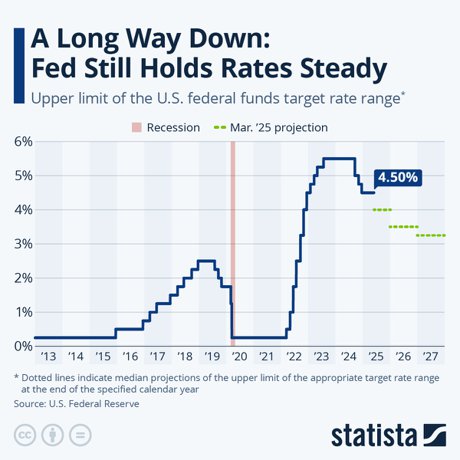
There would be a longer wait for mortgage lenders and potential consumers seeking relief from high interest rates. Following its two-day meeting, the Federal Reserve held rates constant at a range of 4.25% to 4.5% on Wednesday, in a move that was largely anticipated.
The Federal Open Market Committee (FOMC) initiated a pause in January, which is being maintained by this action. That followed a string of rate reductions in late 2024, including two 25-bps reductions in November and December and a 50 basis-point decrease in September.
Powell's comments
Many market watchers have recently pointed out that policymakers are in a challenging position to decide when a rate cut is acceptable. In a press conference on Wednesday, Fed Chair Jerome Powell mentioned that dilemma several times.
We have determined that the risks of both increased inflation and increased unemployment have increased, as we mentioned in our post-meeting statement. … We can't predict which way things will turn out, in my opinion.
"I believe there is a lot of uncertainty regarding, for instance, where tariff policies will settle out and what the effects will be on the economy, GDP, and employment when they do settle out. It's too early to tell, in my opinion. In the end, we believe that our policy rate is stable while we wait for more tariff clarification.
Powell pointed out that the unemployment rate is still very low at 4.2%, even though housing market watchers may be keeping an eye on the labor market for indications of stress. Additionally, he stated that figure is just one piece of information the Fed considers when making policy choices.
To determine whether or not things are indeed getting worse, we would examine the vast array of labor market statistics. Simultaneously, we would be examining the mandate's opposing viewpoint (in reference to inflation). We can find ourselves in a situation where we must strike a balance between those two factors, which is obviously a challenging decision to make.
The FOMC projected two rate cuts in 2025 in March. A reporter questioned Powell on whether the central bank should lower rates this year at all, given the growing apprehension among businesses and consumers as well as the negative risks to unemployment and inflation.
We'll have to watch how this develops. There are some situations when lowering rates this year may be reasonable. In some circumstances, it wouldn't. We simply don't know. … Powell remarked, "I couldn't say with confidence that I know what the appropriate path will be."
There are rumors that, as a result of the high tariffs imposed on China, fewer container ships and imported commodities are reaching important U.S. ports. For instance, Port of Los Angeles officials informed CNN that the volume of cargo is down almost 50% from the previous year, which means that shortages and higher prices will likely be on shop shelves in a few weeks.
Powell was questioned about the potential effects of the tariffs on small firms and if it would be sufficient to trigger a rate reduction.
"The data really doesn't show any significant economic effects yet. He remarked, "We see sentiment." There are worries about potential price increases or similar issues. People are now concerned about inflation. They fear that the tariffs will be a shock. However, that shock hasn't yet occurred.
Signals that contradict
Economists point out that Fed members have chosen to wait and see because of the economic uncertainties brought on by President Donald Trump's global trade policies and concerns about increasing inflation.
According to a statement from Sam Williamson, senior economist at First American, "the committee appears under little pressure to act, choosing instead to 'wait for greater clarity' on the impact of recently announced tariffs before easing monetary conditions," given that inflation is consistently above the FOMC's target and the labor market is showing resilience.
"But as it struggles with the inflationary risks of tariffs and a softening labor market that is causing fears of a recession, the Fed is finding itself facing an increasing challenge," he continued.
The Fed's decision demonstrates a strong labor market in spite of these worries. According to the U.S. Bureau of Labor and Statistics (BLS), non-farm payrolls created 177,000 new jobs in April, more than the 130,000 predicted by economists.
In light of federal government job losses and the impact of budget cuts on economic circulation, Logan Mohtashami, Lead Analyst at HousingWire, stated that the "latest jobs report represents a baseline that may not fully capture the effects of recent events, and as time progresses without a resolution, there is a potential for increased labor market pressures."
Meanwhile, March's year-over-year price increases were 2.4%, down from 2.8% in February and below forecasts, according to inflation statistics. This amount still exceeds the Fed's 2% inflation objective, though.
Fed policymakers are in a "tricky position" because the full effects of the Trump administration's tariffs have only just begun to manifest, leaving inflation rates unknown, according to Melissa Cohn, regional vice president at William Raveis Mortgage.
"May will be a very telling month," according to Cohn, since more information will clarify the administration's initiatives' wider effects. A possible rate cut in June or later may result from this.
"The Fed will not be in a position to lower rates until they are confident that the rate of inflation won't soar," Cohn continued.
Possibilities for borrowing?
The Fed's decision was mostly expected by market participants on Wednesday. Approximately 98% of interest rate traders projected that rates would not change, according to the CME Group's FedWatch program.
On Tuesday, the 30-year fixed-rate conforming loan averaged 6.89%, down 6 basis points from a week earlier, according to HousingWire's Mortgage Rates Center. During the week, the 15-year conforming fixed rate decreased 11 basis points to an average of 6.71%. However, mortgage rates were 20 to 30 basis points lower just a few weeks prior.
"The 10-year U.S. Treasury Note yields, which are a benchmark that mortgage rates loosely follow, have increased due to investor uncertainty about the impact of tariffs," Williamson added.
"Mortgage rates are expected to drop from their current levels, providing further relief to potential home buyers, as the Fed prepares to resume rate cuts in the second half of the year."
According to analysts at Keefe, Bruyette, and Woods, assuming that a 50-bps incentive is required for a customer to refinance, about 3% of mortgage holders are currently in the money to do so. These shares would rise to 15.7% and 26.6%, respectively, if rates dropped by 100 or 200 basis points.
The Fed's twin mandate, according to Geno Paluso, CEO of mortgage servicing technology company Sagent, entails striking a difficult balance between promoting the labor market with lower rates and containing inflation with higher rates.
"While the Fed tries to hold rates steady for trade war inflation signals, the White House will continue to put pressure on the Fed to cut rates in order to avoid a recession," Paluso stated.
Paluso clarified that although a recession would benefit stable homeowners by allowing them to refinance their loans at reduced rates, it would also result in challenges for homeowners who might lose their jobs or income. Similarly, he said, a tariff-driven increase in inflation may also hurt homeowners.
Consider buying a home while rates are stable. Check out the Hersey Group.