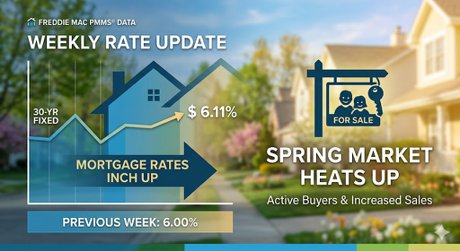
If you were hoping for mortgage rates to continue their downward slide this week, the latest data from Freddie Mac might feel like a bit of a "spring chill." After dipping below the 6% mark recently for the first time in years, interest rates saw a modest uptick this week.
According to the latest Primary Mortgage Market Survey® (PMMS®) released on March 12, 2026, the 30-year fixed-rate mortgage (FRM) averaged 6.11%.
Here’s a breakdown of what this week’s numbers mean for homebuyers and the housing market at large.
The Numbers: Where We Stand This Week
Freddie Mac’s weekly survey provides a snapshot of the national average for conventional, conforming home purchase loans. Here is the data for the week ending March 12:
-
30-Year Fixed-Rate Mortgage: Averaged 6.11%, up from last week’s 6.00%.
-
15-Year Fixed-Rate Mortgage: Averaged 5.50%, up from last week’s 5.43%.
-
The Silver Lining: While rates ticked up this week, they remain significantly lower than this time last year, when the 30-year FRM sat at 6.65%.
Why the Sudden Uptick?
Mortgage rates don’t move in a vacuum; they are heavily influenced by the 10-year Treasury yield, which has been reacting to a mix of global and domestic factors.
Chief among these is the ongoing geopolitical tension in the Middle East. Recent military escalations have stoked fears of "wartime inflation," causing investors to pull back from bonds and pushing yields higher. Additionally, while recent jobs data showed some softening in the labor market (with unemployment ticking up to 4.4%), the "risk premium" associated with global uncertainty is currently outweighing those cooler economic signals.
The Surprise: Buyers Aren't Backing Down
In past years, an 11-basis-point jump might have sent shockwaves through the market. However, Freddie Mac Chief Economist Sam Khater noted a surprising trend: resilience.
Despite the modest increase, housing activity is actually picking up. Existing-home sales rose by 1.7% in February, and purchase applications—a leading indicator of future sales—increased this week.
It seems that after years of volatility, buyers have adjusted their expectations. Rates in the 6% range are being viewed as a "new normal" and a significant improvement over the 7% and 8% peaks seen in late 2023 and 2024.
What This Means for You
If you’re currently in the market for a home, here are three takeaways:
-
The "Spring Season" is Early: The increase in application activity suggests that the spring homebuying season is starting with plenty of competition. Don't wait for "perfect" rates if you find the right home; the inventory shortage still makes competition fierce.
-
Context is Key: Rates are more than half a percentage point lower than they were a year ago. On a $400,000 loan, that difference can save a homeowner roughly $150 per month in interest.
-
Stability over Volatility: Most experts, including those at Fannie Mae and the Mortgage Bankers Association, expect rates to hover between 6.0% and 6.2% for the remainder of the quarter. While we might see minor fluctuations, the era of drastic weekly swings appears to be stabilizing.
The Bottom Line
This week’s move to 6.11% is a reminder that the path to lower rates is rarely a straight line. However, with inflation drifting lower and the housing market showing remarkable energy, the overall outlook for 2026 remains one of "cautious opportunity."