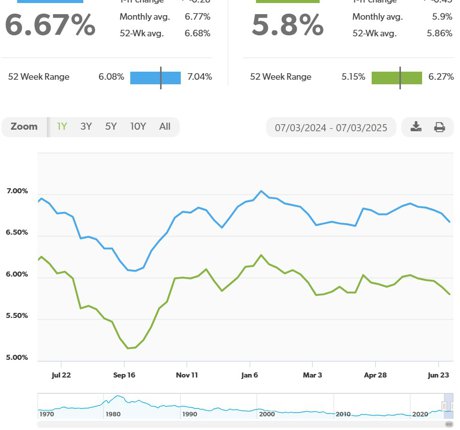
Mortgage rates kept going down on Thursday, hitting a 12-week low just before the holiday weekend. This was because markets were waiting for important economic data before the next Federal Reserve policy meeting.
Freddie Mac said that the average rate on 30-year fixed home loans fell from 6.77% last week to 6.67% for the week ending July 3. During the same time in 2024, rates were 6.95% on average.
It was the greatest drop in mortgage rates in a week since March, and the lowest level since early April, when President Donald Trump's announcement of the Liberation Day tariff sent long-term bond yields crashing.
This week, though, there weren't many headlines that would have made mortgage rates go down. Investors may have just been moving their money around in preparation for the end of the month and the second quarter.
The financial markets were also becoming more hopeful that the Federal Reserve will drop rates later this month. However, those aspirations were crushed on Thursday morning when the June jobs report showed strong job growth that was better than expected.
No matter why they are going down, the drop in mortgage rates before Independence Day will be good news for anyone who want to purchase a home but can't find one that fits their budget.
"Mortgage rates going down is a good sign, and even though there are still problems with affordability, we are seeing more sellers enter the market, which gives buyers an edge," says Sam Khater, Freddie Mac's chief economist.
According to the Realtor.com® economic research team's weekly housing analysis, new listings and active inventory continued to grow on an annual basis for the week ending June 28. Homes also spent longer on the market.
According to data from the Mortgage Bankers Association, mortgage purchase applications rose 16% last week compared to the same time last year. This shows that buyers are once again interested following a poor spring season.
The increase comes after a slow May, when sales of new homes fell 6.3% from the same month last year and sales of existing homes fell 0.7% year over year.
"Sales are going down, which is causing inventory levels to rise a little. This will help make the housing market more buyer-friendly, but the process is expected to be slow because the economy is still uncertain," says Anthony Smith, Senior Economist at Realtor.com.
How to figure out mortgage rates
A complicated math problem that takes into account the state of the economy and a person's financial health decides mortgage rates. The 10-year Treasury bond yield is the best indicator of how they are doing. It shows how the economy is doing and how people expect inflation to rise. Before adding their own margin to cover costs, risks, and profit, lenders look at this benchmark.
When the economy shows signals of growing inflation, Treasury yields usually go up, which makes mortgage rates go up as well. On the other hand, indicators of declining inflation or a sluggish job market usually make Treasury yields go down, which makes mortgage rates go down.
But the mortgage rates that a lender offers you are based on more than just these benchmarks. They also take into account some of your own circumstances.
Your lender will look closely at your credit score, loan amount, kind of property, quantity of down payment, and loan duration to figure out how risky you are. People with better credit scores are seen as less risky and usually get lower rates. People with worse credit scores are seen as more risky and earn higher rates.
Need a lender to get qualified to purchase a home? Reach out to the Hersey Group for recommendations.