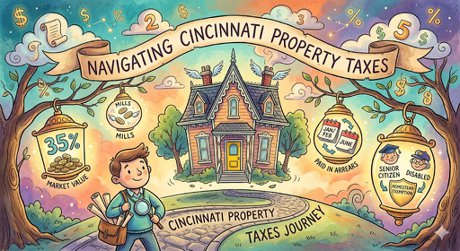
If you own a home in Cincinnati—or are looking to buy here—you've likely noticed that property taxes have been a major topic of conversation lately. Between recent county-wide reappraisals and complex-sounding terms like "millage rates" and "HB 920," the whole system can feel like a riddle wrapping a math problem.
But it doesn't have to be. Let’s strip away the jargon and break down exactly how Cincinnati property taxes work, how they are calculated, and what you need to look out for on your bill.
1. The Core Calculation: The 35% Rule
One of the most unique things about Ohio property tax is that you are never taxed on the full market value of your home. Instead, you are taxed on its Assessed Value (also called the taxable value), which is exactly 35% of the appraised market value.
If the county appraises your home at $300,000, your calculation starts like this:
Your tax bill is built entirely around that $105,000 figure, not the full $300,000.
2. Understanding "Mills"
Property tax rates in Hamilton County aren't expressed as simple percentages. Instead, they use a system called millage.
What is a mill? One mill represents $1 of tax for every $1,000 of your home's assessed value.
Your total tax rate is a combination of different mills voted on by the public to fund local services. In Cincinnati, the vast majority of your property taxes (typically around 60%) goes directly to fund local school districts. The rest is split between city services, the county, and special library, park, or zoo levies. Because each neighborhood sits in specific voting districts, your exact millage rate changes depending on whether you live in Over-the-Rhine, Hyde Park, or Sayler Park.
3. The 3-Year and 6-Year Valuation Cycle
The Hamilton County Auditor is required by state law to put every property through a mass appraisal system to determine its fair market value. This happens on a rolling, predictable schedule:
-
Every 6 Years (Sexennial Reappraisal): The county performs a full, comprehensive review of every property.
-
Every 3 Years (Triennial Update): Midway through that cycle, the auditor performs a simpler value update based on recent neighborhood sales data to keep pace with the real estate market.
Because the Greater Cincinnati housing market has been incredibly hot over the last few years, the recent valuation cycles saw historic jumps in property values across Hamilton County—sometimes spiking market values by more than 30% in a single cycle.
4. Why a 30% Value Jump Doesn't Mean a 30% Tax Jump
This is the piece of the puzzle that trips up almost everyone. If your property value skyrockets, your tax bill will likely go up, but it won't go up at the exact same rate.
This is thanks to an Ohio law called House Bill 920. Passed in the 1970s, HB 920 protects homeowners from "sticker shock" by putting a brake on inflation. When voters pass a local tax levy, it is approved to collect a fixed dollar amount for that service, not a fluctuating percentage.
If property values in a neighborhood spike across the board, the state automatically scales down the effective millage rate so the levy still collects the exact same total pool of money. Your taxes generally only jump significantly if your specific home outpaced the neighborhood average, or if voters approved brand-new levies on the ballot.
5. Credits, Reductions, and the "In Arrears" Rule
When you finally look at your bill, there are a few built-in mechanisms and quirks you need to know:
-
Tax Reductions: Most homeowners qualify for the Owner-Occupied Tax Credit, which shaves a 2.5% reduction off of eligible local levies if the property is your primary residence.
-
The Homestead Exemption: If you are a senior citizen (65 or older) or permanently disabled, and meet specific income thresholds, you can shield up to $25,000 of your market value from being taxed at all.
-
Paid in Arrears: In Ohio, property taxes are paid a year behind. The bill you pay in January or February covers the first half of the previous calendar year, and the bill you pay in June covers the second half.
The Takeaway
Understanding how these pieces interact makes it much easier to budget for your monthly escrow payments, evaluate a home's true cost when shopping, or decide if your new county valuation is worth disputing.
If you ever feel your appraised value is significantly higher than what your home would actually fetch on the open market, you have the right to file an official appeal with the Hamilton County Board of Revision between January 1st and March 31st to argue for a reduction.