Few neighborhoods in America tell a story as layered, beautiful, and deeply complicated as Over-the-Rhine (OTR) in Cincinnati. Known for possessing one of the largest and most intact collections of 19th-century urban historic architecture in the United States, OTR has lived several completely different lives.
To look at its housing history is to look at a mirror of American urban policy: from dense immigrant enclave to severe mid-century disinvestment, into one of the country's most intense case studies of rapid corporate-driven gentrification.
1. The Immigrant Boom and the "Rhine" (1850s–1910s)
The neighborhood got its distinct name from the influx of German immigrants in the mid-19th century. To get to work from downtown, they had to cross the Miami and Erie Canal. Jokingly, they likened the canal to the River Rhine in Germany, meaning they lived "Over the Rhine."
To accommodate thousands of working-class families, local builders erected dense blocks of narrow, 3- to 5-story brick tenements.
-
The Design: Built primarily between 1865 and 1890, the architecture favored a mix of Italianate and Queen Anne styles. They featured high ceilings, large windows, and highly ornate exterior cornices.
-
The Living Conditions: OTR was incredibly dense. It was common for an entire family to live in a single- or two-room apartment. Retail storefronts anchored the first floors, breweries occupied the northern edge, and families lived stacked tightly above.
2. Prohibition, Flight, and Disinvestment (1920s–1990s)
The neighborhood's first massive economic shock hit with Prohibition in 1920. OTR’s economic engine—its legendary beer brewing industry—was decimated overnight.
Following World War II, the neighborhood underwent a dramatic demographic and structural shift:
-
The Shift: As older German-American families moved out to the surrounding hills and suburbs, the vacant housing stock became a landing pad for new residents. This included Appalachian migrants looking for factory work and thousands of African Americans displaced by urban renewal projects in Cincinnati's nearby West End neighborhood.
-
The Decay: Landlords practicing absentee ownership began dividing the historic apartments into smaller, cheaper sub-units while neglecting maintenance. As manufacturing jobs dried up, the city funneled fewer resources into the area. By the late 20th century, the poverty rate in OTR exceeded 50%, homeownership dropped to as low as 4%, and hundreds of historic buildings sat completely abandoned, crumbling from structural neglect.
3. The Turning Point: 2001 and the Rise of 3CDC (2000s–2010s)
By 2001, frustrations over economic disparity and racial injustice boiled over into a multi-day civil unrest following the police shooting of an unarmed Black teenager, Timothy Thomas. OTR was at the epicenter. Realizing the city’s core was on the verge of complete collapse, Cincinnati’s corporate and civic leaders took a highly unusual path.
In 2003, they formed the Cincinnati Center City Development Corporation (3CDC)—a private, non-profit real estate corporation backed by the city’s massive corporate heavyweights (like Procter & Gamble and Kroger).
The "Gateway Quarter" Playbook
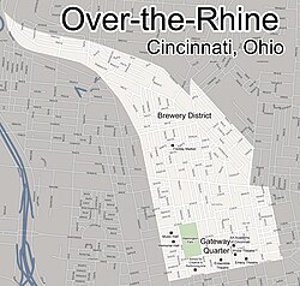
Instead of typical piecemeal development, 3CDC bought up vast swaths of contiguous vacant property and abandoned buildings at once. They concentrated their efforts block-by-block, heavily focusing on the southern edge of OTR (dubbed the "Gateway Quarter") and the revitalization of historic Washington Park.
The strategy worked with breathtaking speed. Crumbling brick shells were transformed into high-end condominiums, upscale boutiques, trendy bars, and artisanal restaurants. OTR went from being listed as one of America's "Most Endangered Historic Places" to a national model for urban "smart growth."
4. OTR Today: The Modern Housing Tightrope
Today, OTR is a stunning visual paradox. Walk down Vine or Main Street, and you will see historic 19th-century brick facades preserved meticulously to federal historic standards, but sitting beneath them are $500,000+ luxury condos and $15 cocktails.
The central debate in OTR’s modern housing landscape centers heavily on equity and displacement.
Today, the neighborhood has expanded its revival further north toward Findlay Market and TQL Stadium. The current era is defined by a tense, ongoing negotiation: figuring out how to celebrate and preserve OTR's peerless architectural history without entirely erasing the human history of the working-class communities who lived there when the rest of the city had turned its back.