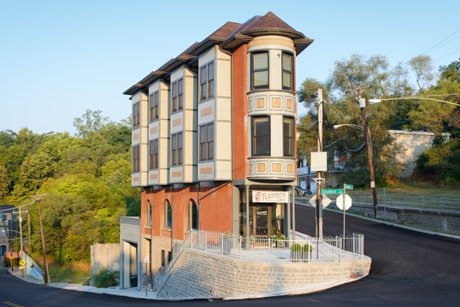
Perched on the bluffs directly north of Over-the-Rhine and Downtown, Mt. Auburn is one of Cincinnati’s most historically rich hilltop neighborhoods. Designated as the city's first hilltop suburb in the 1830s, Mt. Auburn offered 19th-century residents a scenic retreat above the industrial river basin below.
Today, Mt. Auburn stands at the crossroads of preservation and modernization. Driven by its proximity to major medical centers, universities, and downtown transit loops, this historic enclave continues to attract home buyers, healthcare professionals, and real estate investors looking for architectural integrity and central connectivity.
The Real Estate Landscape: High-Equity Modernization & Architectural Density
The housing inventory in Mt. Auburn features a distinct dual profile. The neighborhood’s historic core showcases grand Greek Revival, Italianate, and Queen Anne mansions alongside brick row houses and converted multi-unit properties. Meanwhile, ongoing hill-slanted infill development has introduced modern luxury condominiums and customized townhomes designed to maximize skyline views.
| Market Metric | Current Value |
| Median Listing Price | ~$540,000 to $576,000 |
| Median Price per Sq. Ft. | ~$279 to $291/sq. ft. |
| Median Days on Market | ~57 to 66 days |
| Housing Mix | Grand Victorian estates, historic brick row houses, modern luxury infill condos |
Strategic Insights for Buyers & Investors
Mt. Auburn presents a wide variance in price point based on location and views. Full single-family restorations and new hillside luxury builds along streets like Prospect Hill command premium prices due to panoramic views of the Cincinnati skyline. Multi-unit brick properties and historic fixer-uppers offer long-term equity upside for investors, supported by constant rental demand from nearby hospital networks and higher education campuses.
Culture & Historic Heritage: Presidential Roots & Arts
Mt. Auburn’s identity is deeply rooted in American history and grassroots community preservation.
-
William Howard Taft National Historic Site: Located on Auburn Avenue, this restored 1840 Greek Revival home is the birthplace and childhood residence of William Howard Taft, the 27th U.S. President and 10th Chief Justice of the Supreme Court. The site features a public museum and administrative educational space.
-
The Glencoe-Auburn Historic District: Highlighted by architectural preservation efforts, Mt. Auburn features multiple sites listed on the National Register of Historic Places, preserving mid-to-late 19th-century urban residential planning.
-
Prospect Hill Enclave: The southern slope of Mt. Auburn, known as Prospect Hill, acts as an arts-infused sub-pocket known for its steep brick steps, colorful historic homes, and tight-knit neighborhood preservation groups.
Parks, Recreation, & Scenic Green Spaces
Despite its high-density urban geography, Mt. Auburn offers access to scenic overlooks and preserved green spaces.
-
Inwood Park: Spanning over 16 acres along Vine Street, Inwood Park features a historic pavilion, stone walking paths, open lawns, and recreational sports space.
-
Jackson Hill Park: Situated on the southern boundary of Mt. Auburn, Jackson Hill Park offers expansive hillside green space and some of the best unobstructed vantage points of the Downtown skyline and Over-the-Rhine below.
-
Hopkins Park: Located at the intersection of Bigelow Street and Auburn Avenue, this quiet pocket park provides shaded seating, manicured flower beds, and neighborhood gathering spaces.
Strategic Location & Healthcare Infrastructure
Logistically, Mt. Auburn serves as an essential bridge between Downtown Cincinnati and the Uptown Innovation Corridor.
-
Medical Hub Proximity: Mt. Auburn is home to The Christ Hospital Health Network, a multi-block medical campus that consistently ranks among the region's top healthcare providers and employers. It sits directly adjacent to UC Health, Cincinnati Children's Hospital, and Good Samaritan Hospital.
-
Academic Accessibility: Situated directly between the University of Cincinnati campus and Downtown, the neighborhood provides effortless transit options for university faculty, researchers, and students.
-
Commuter Connectivity: Residents enjoy direct road routes down Sycamore, Main, and Liberty Streets into Over-the-Rhine and the Central Business District in under 5 minutes, as well as rapid access to I-71.
The Bottom Line: Mt. Auburn delivers an exceptional blend of 19th-century architectural heritage, expanding medical-sector equity, and premier skyline views, making it one of Cincinnati's most compelling hilltop real estate markets.