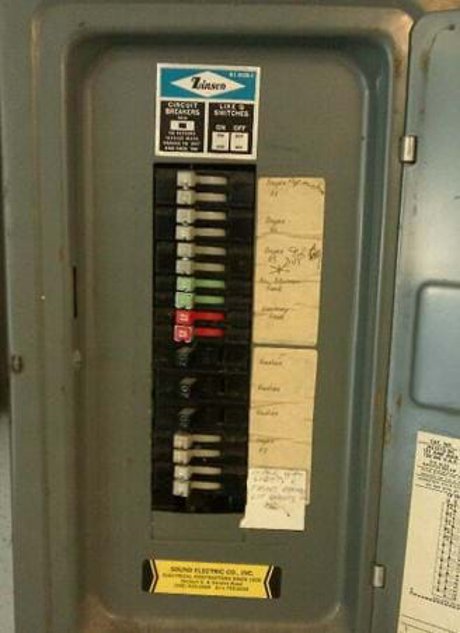
Your home’s electrical panel is essentially the "brain" of your house. When it works, you don't even think about it. But when it fails, it doesn't just leave you in the dark—it can become a significant fire hazard.
While most modern panels are built to rigorous safety standards, several brands from the mid-to-late 20th century have since been identified as dangerous. If your home was built or renovated between the 1950s and the 1980s, you might be sitting on a ticking time bomb.
Here are the four breaker panels that every homeowner should check for.
1. Federal Pacific Electric (FPE) Stab-Lok
This is perhaps the most notorious name in the industry. Millions of these panels were installed across North America between the 1950s and 1980s.
-
The Issue: The "Stab-Lok" breakers frequently fail to trip when they detect an overload or short circuit. If a breaker doesn't trip, the wires overheat, the insulation melts, and a fire starts.
-
The Danger: Testing has shown these breakers have a failure rate as high as 25% to 60%.
-
How to Identify: Look for the "Federal Pacific" name on the cover and "Stab-Lok" written inside. The breakers often have distinct orange tips.
2. Zinsco (or GTE-Sylvania)
Zinsco panels were incredibly popular in the 1970s. While they were a staple of suburban growth, they harbored a design flaw that only became apparent over time.
-
The Issue: The connection between the breakers and the bus bar (the metal rail that carries the power) often becomes loose. This causes arcing, which generates intense heat.
-
The Danger: The heat can actually fuse the breaker to the bus bar. This means the breaker cannot be turned off, even manually, and it won't trip during a power surge.
-
How to Identify: Look for the Zinsco name or a "Sylvania" or "GTE-Sylvania" label. The breakers are usually brightly colored (blue, red, pink, and green).
3. Challenger
Challenger panels were manufactured in the 1980s and 1990s and were installed in thousands of new housing developments.
-
The Issue: Much like Zinsco, these panels suffered from overheating at the connection point between the breaker and the bus bar.
-
The Danger: The overheating is often "silent"—it happens inside the panel without tripping any breakers until the unit actually melts or catches fire.
-
How to Identify: The door of the panel will usually have a "Challenger" logo. These are often found in homes built during the 80s expansion.
4. Pushmatic (ITE/Bulldog)
Unlike the others, Pushmatic panels weren’t necessarily "cheaply made," but their unique design hasn't aged well.
-
The Issue: These panels use a grease-fed "push-button" mechanism instead of a flip switch. Over decades, that grease dries out, making the buttons stiff or impossible to operate.
-
The Danger: If the mechanism sticks, the breaker may fail to trip during an electrical fault. Additionally, Pushmatic panels are "main lug" panels, often lacking a main disconnect to shut off power to the whole house in an emergency.
-
How to Identify: Look for rectangular buttons you push "On" and "Off" rather than switches.
What Should You Do?
If you find one of these brands in your garage or basement, don't panic, but do take action.
-
Don't DIY: Electrical panels are high-voltage environments. Never attempt to pull breakers out of these specific panels yourself, as they are prone to crumbling or arcing.
-
Get an Inspection: Hire a licensed electrician to perform a thermal scan or a physical inspection.
-
Plan for Replacement: If you have an FPE or Zinsco panel, most electricians (and insurance companies) will recommend a full replacement. It's an investment in your safety—and your home's resale value.